
Becoming a Swiss Cross-Border Commuter - The Practical Guide 2026
Work in Geneva or Vaud while living in France. A complete guide with real savings, concrete steps, and what no one tells you about the life of a cross-border worker.
Becoming a Swiss Cross-Border Commuter: The Practical Guide 2026
"Swiss salary, French rent—the perfect deal!"
When Mathieu saw the ad (web developer, CHF 95,000, Geneva), he immediately calculated: living in Annemasse (€1,200 for a 3-room apartment), working in Geneva (CHF 6,500 net monthly), massive savings guaranteed.
Two years later, stuck in traffic at the Moillesulaz customs for the 487th time, Mathieu wonders if the "perfect deal" really is. He saves CHF 900/month, certainly, but he has lost 800 hours in traffic this year. And the Franco-Swiss administration has made him fill out more forms than in his entire previous life.
The cross-border commuter status offers real financial opportunities—around 90,000 French people work in French-speaking Switzerland. But it is also a specific lifestyle with its constraints, its paperwork, and its particular daily life. This guide explains everything that no one frankly tells you before you get started.
Key figure: According to the Office cantonal de la statistique genevoise, cross-border commuters represent 37% of the workforce in Geneva and save an average of CHF 1,200/month compared to Swiss residents, but spend 520 hours per year in transport (source: OCSTAT).
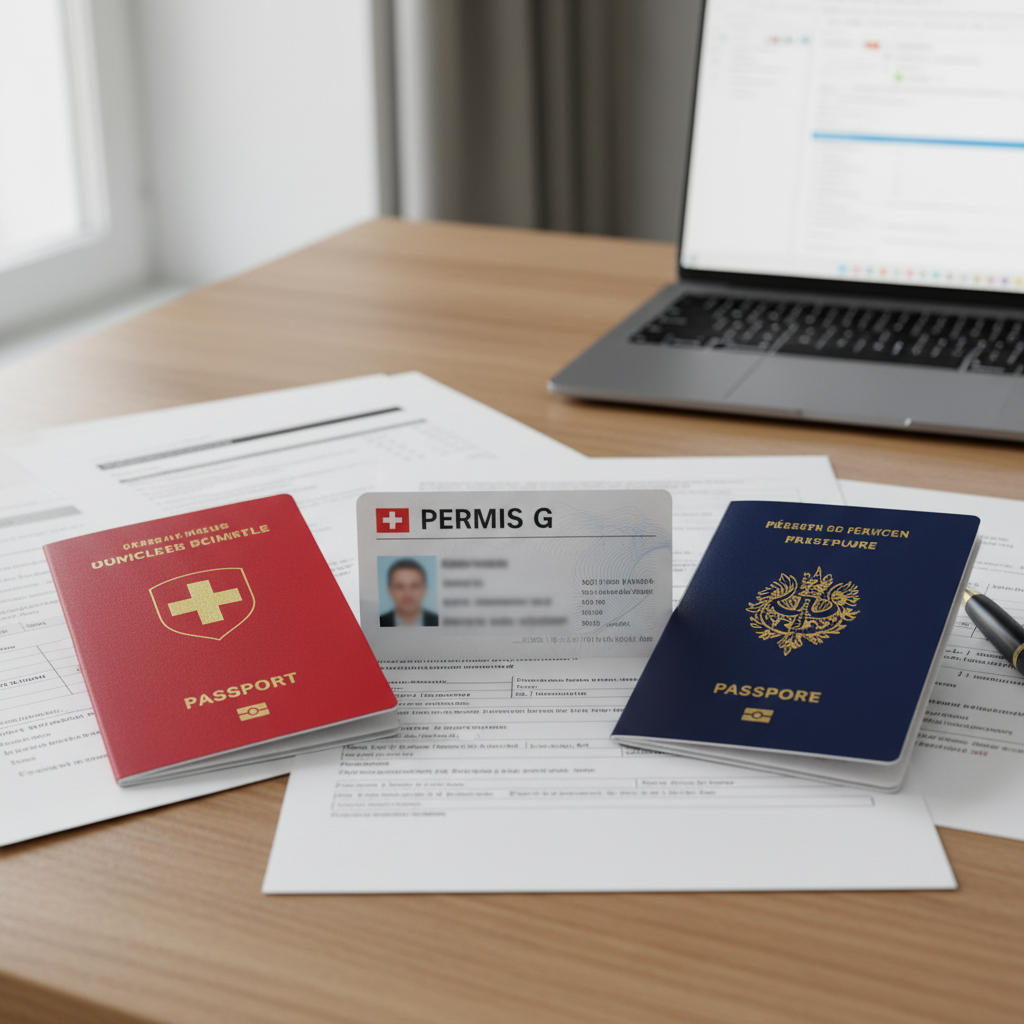 Photo par Tima Miroshnichenko sur Pexels - The cross-border commuter status makes you juggle between two countries and two administrative systems
The Cross-Border Commuter Equation: The Real Numbers
Before diving into the procedures, let's lay out the real numbers. Is it really worth it financially?
Sophie's Case: Developer in Geneva
Scenario A - Swiss Resident (Carouge)
Gross salary: CHF 90,000 Net monthly after taxes: CHF 5,640 2-room apartment rent in Carouge: CHF 1,900 LAMal insurance: CHF 520 Transportation (TPG): CHF 70 Food: CHF 650 Remaining available: CHF 2,500/month
Scenario B - Cross-Border Commuter (Annemasse)
Gross salary: CHF 90,000 Net monthly after withholding tax (4.5%): CHF 6,280 2.5-room apartment rent in Annemasse: €1,100 (CHF 1,210) Cross-border commuter insurance: CHF 180 Gas + parking: CHF 380 Food in France: CHF 520 Remaining available: CHF 3,990/month
Cross-border commuter savings: CHF 1,490/month or CHF 17,880/year
But this calculation omits the invisible cost: Sophie spends 3 hours daily in transportation (1h30 morning, 1h30 evening). Over a year: 750 hours—the equivalent of 18 weeks of full-time work.
Do you value your time at CHF 0? If so, the cross-border commuter wins. If your time has value, recalculate. At CHF 50/hour, these 750 hours are worth CHF 37,500—much more than the savings achieved.
The Permit G: Your Administrative Key
The Permit G (cross-border commuter) is not automatic. Here's how to get it without a hitch.
The Strict Conditions
You must meet ALL of these conditions simultaneously:
Condition 1: Swiss employment contract No permit without a job. The employer applies, not you.
Condition 2: Residence in the border zone Authorized departments for Geneva: Ain (01), Haute-Savoie (74) For Vaud: Ain (01), Doubs (25), Jura (39)
You CANNOT live in Lyon, Grenoble, Besançon—too far from the border.
Condition 3: Minimum weekly return Theoretically daily, but control over minimum weekly return. No question of squatting a Swiss apartment during the week.
The 4-Step Process
Step 1: Your employer submits the application Required documents sent to the Service cantonal de l'emploi. Deadline: 3-6 weeks for review.
Step 2: Pre-authorization received You can start working with this temporary pre-authorization.
Step 3: Resident control Within 14 days of your start, register at the population office of your Swiss municipality of work.
Step 4: Definitive Permit G Plastic card received by mail. Valid for 5 years, automatically renewable if employment continues.
Photo par Anthony Beck sur Pexels - The border area strictly defines where you can live
Health Insurance: The Crucial Choice
This is THE dilemma for every cross-border worker. Three options, each with advantages and pitfalls.
Option 1: Swiss LAMal (The Secure One)
How it works: You take out classic Swiss health insurance like any resident. Full coverage in Switzerland AND France.
Advantages: Care in Switzerland without restriction Care in France reimbursed correctly Excellent hospital network on both sides Administrative simplicity
Disadvantages: High premium: CHF 400-550/month (Geneva/Vaud) Obligation to keep it even if you become a pure French resident later
For whom: You consult regularly You have known health problems Comfortable budget You value peace of mind
Option 2: French CMU (The Economical One)
How it works: You remain affiliated with the French system. Contribution: approximately €60-80/month via CPAM.
Advantages: Very low cost You stay in the French system French Social Security reimbursements
Disadvantages: Coverage in Switzerland limited to emergencies Many French doctors refuse CMU cross-border workers (administrative overload) Reimbursements sometimes complicated If emergency in Switzerland: you advance the costs
For whom: Tight budget Excellent health You rarely consult You accept administrative constraints
Martin's testimony: "I took the CMU to save money. Big mistake. My GP refused to keep me as a patient. I had to look for another one for 4 months. When I injured myself skiing in Verbier, I had to advance CHF 3,500. Reimbursement: 6 months later, partially. I switched to LAMal after 18 months of hassle."
Option 3: Private Cross-Border Insurance (The Compromise)
How it works: Specialized cross-border insurance (Groupe Mutuel, Assura, CSS). Coverage France + Switzerland.
Advantages: Intermediate price: CHF 150-250/month Coverage of both countries Customer service understands cross-border workers Simplified procedures
Disadvantages: Medical network sometimes limited Specific conditions depending on the insurer Medical questionnaire (possible exclusions)
For whom: You are looking for a price-coverage balance Correct health without major needs You want France-Switzerland flexibility
My advice: If you can afford CHF 350-400/month, take the Swiss LAMal. It is the least risky and administratively simplest solution.
Cross-Border Taxation: Less Simple Than It Seems
Where do you pay your taxes? In Switzerland, in France, or both? Here's the real answer.
What You Pay in Switzerland
Automatic Withholding Tax Your Swiss employer deducts approximately 4.5% of your gross salary for Geneva (special cross-border rate according to the Franco-Swiss agreement). For Vaud, approximately 3-5% depending on your situation.
Marc, single, CHF 85,000 in Geneva: approximately CHF 320/month of Swiss tax.
This ultra-low rate is the main tax advantage of cross-border status.
What You Must Do in France
Mandatory declaration of your Swiss income to the French tax authorities, even if you don't pay French tax on it (thanks to the tax treaty).
This income is "exempt" but taken into account to calculate your tax rate on other potential French income (rent, investments, etc.).
Concrete example: Sophie, cross-border worker, earns CHF 90,000 in Switzerland + €10,000 in rent in France. Her CHF 90,000 from Switzerland: €0 of French tax Her €10,000 in rent: taxed at the rate calculated on (CHF 90K + €10K)
Without the Swiss income, she would pay 14% on the rent. With the Swiss income taken into account, she pays 28% on the rent.
Is it complex? Yes. Is it legal? Yes. Do you need an accountant? Probably the first year (CHF 300-500).
Cross-Border Commuting: Real Life
Beyond the numbers, let's talk about what it means concretely on a daily basis.
Mathieu, 2 Years as a Cross-Border Commuter
6:15 AM - Wake up. Quick coffee. 6:45 AM - Departure from Annemasse. Almost empty road, 20 minutes to the border. 7:05 AM - Bardonnex border crossing. Sometimes 5 minutes, sometimes 25. Unpredictable. 7:35 AM - Arrival at Cornavin parking (CHF 180/month). Tram to the office. 8:00 AM - At the office, often the first to arrive.
5:15 PM - Departure from the office. 6:00 PM - Border crossing (return is always slower). 30-45 minutes of standard waiting time. 6:50 PM - Arrival in Annemasse, quick shopping. 7:30 PM - At home, tired.
Total: 13 hours and 15 minutes away from home, including 3 hours and 15 minutes of pure transportation.
Mathieu has been doing it for 2 years. Saves CHF 1,100/month (CHF 26,400 over 2 years—enough to buy a car). But he admits: "Some evenings, I wonder if it's worth it. The time lost with my family, the accumulated fatigue. I'm considering moving to Switzerland in 2-3 years."
Cross-border commuting is not a definitive solution for many. It is often a transitional phase of 2-5 years to save quickly.
Strategies That Work
Teleworking 2 days/week Drastically reduces fatigue. Clémentine works Monday-Tuesday-Friday in the office, Wednesday-Thursday at home. She keeps the financial benefits with half as many trips.
Staggered hours Antoine arrives at the office at 7:30 AM, leaves at 4:30 PM. He avoids the worst rush hour. Saves 1 hour per day (250 hours/year).
Secondary customs offices Instead of Bardonnex/Moillesulaz (saturated), use Veigy-Foncenex, Archamps, Viry. Sometimes 10 km more but 30 minutes less.
Audiobooks and podcasts Transforms wasted time into learning time. Julie listens to 1 book per week during her commutes. 50 books per year that she would never have read otherwise.
Your First Weeks: The Survival Guide
Week 1: Adaptation
Allow plenty of time for your first journeys. Leave 30 minutes earlier than necessary—you'll discover the real traffic.
Download Google Maps and Waze. Both. Waze alerts you to blocked customs posts. Google Maps offers you alternatives.
Identify 2-3 different customs posts on your route. Some days, changing customs posts saves 20 minutes.
Week 2-4: Optimization
Test different schedules. Leaving 30 minutes earlier in the morning radically changes your experience. Returning at 4:45 p.m. instead of 5:30 p.m. too.
Identify affordable long-term parking on the Swiss side (CHF 100-180/month instead of CHF 250+ in the center). Many are on the outskirts, well connected by tram.
Join the Facebook groups for cross-border commuters. Real-time alerts on blocked customs posts, parking tips, good deals. This community is golden.
Month 2-3: The Routine
You've found your rhythm. You know the customs posts by heart, you anticipate traffic, you have your favorite podcasts.
Now is the time to finalize your choice of health insurance (3-month deadline). Don't procrastinate—some insurers have activation delays.
Check your first payslip in detail. Withholding tax correct? Contributions properly calculated? Errors are frequent in the first few months.
Photo par Adrien Olichon sur Pexels - The reality of the daily cross-border commute requires organization and resilience
Beginner Mistakes to Avoid
Mistake #1: Living Too Far Away
Thomas took a house in Rumilly (35 km from Geneva). "Great house, garden, quiet!" Actual commute: 1h15 minimum in the morning, 1h45 in the evening. He cracked after 10 months, moved to Annemasse.
Golden rule: Maximum 20 km from the Swiss border. Beyond that, you will suffer.
Mistake #2: Underestimating Traffic Jams
The customs in the morning 7:30-9am and in the evening 5-7pm, it's hell. Julie, naive, thought "20 minutes Annemasse-Geneva center." Reality: 1h15 on average.
Solution: Visit the customs during peak hours BEFORE accepting the job. Actually experience the journey. No surprises afterwards.
Mistake #3: Choosing CMU Without Knowing the Constraints
Paul took the CMU "to save CHF 400/month." Problem: ski accident in Verbier. CHF 5,200 in fees advanced. Partial reimbursement 8 months later. In the meantime, he struggled financially.
Solution: LAMal if you play risky sports, have medical history, or want to sleep soundly.
Mistake #4: Not Declaring in France
Marc thought that paying in Switzerland was enough. The French tax authorities found him 2 years later. Tax adjustment, penalties, stress. CHF 3,000 in fees and 18 months of hassle.
Solution: ALWAYS declare your Swiss income in France. It is mandatory even if you don't pay taxes on it.
Your Ideal Timeline
3 Months Before Starting
You have signed your Swiss contract. Here is the optimal order of steps.
Week 1-2 after signing: Search for and find your accommodation in the French border area. Obtain proof of address from the town hall (necessary for permit G).
Week 3-4: Your employer submits the application for permit G with all documents (contract, proof of address, passport, diplomas).
Week 5-8: Waiting for permit G. During this time, research health insurance options and compare Swiss banks.
1 Month Before Starting
Week 9-10: Permit G received. Immediately open your Swiss bank account with the permit.
Week 11-12: Test your commute during peak hours (really do it!). Register with the Swiss residents control. Start health insurance procedures.
First Week of Work
Day 1-2: Submit all documents to HR (permit G, bank details, insurance certificate). Check that they have your AVS number or request it.
Day 3-5: Refine your commute routine. Identify alternative customs. Optimize your schedules.
First Month
Week 2-3: First payslip. Check everything in detail. Source tax correct? Contributions good? Net salary corresponds to forecasts?
Week 4: Finalize health insurance choice (deadline 3 months but better to anticipate). Declare your situation to the French tax authorities.
Key Points to Remember
Becoming a cross-border worker offers real savings opportunities but requires rigorous organization and acceptance of daily constraints. Three essential truths: Firstly, the real economy after all expenses revolves around CHF 800-1,200 monthly (not the CHF 2,000 often promised)—substantial but less spectacular than announced. Secondly, travel time (2-4h daily) represents 500-800 lost hours annually—this invisible cost must be valued in your overall calculation. Thirdly, cross-border status is often transitional (2-5 years) to save quickly before either moving to Switzerland or returning to France with accumulated capital—it is rarely a lifelong solution.
Choose cross-border if you prioritize rapid savings over daily comfort, accept double administrative constraints, and have a medium-term time horizon. Avoid if you value your free time, hate commuting, or seek long-term stability.
Official Resources
- OCPM Genève - Permis frontalier - Official procedures for permit G for Geneva
- Canton de Vaud - Frontaliers - Information on cross-border permit Vaud
- Frontalier.org - Reference site with practical guides and news
- Groupement Transfrontalier Européen - Legal and social information
- CPAM - Frontaliers - French health insurance for cross-border workers
- TPG Genève - Transports - Geneva public transport network
Related Articles
Calculate your net cross-border salary Our calculator integrates the specific cross-border withholding tax rates (4.5% Geneva, 3-5% Vaud). See exactly how much you will receive after all deductions.
Choosing your canton in Switzerland Cross-border worker vs Swiss resident: complete financial comparison. Find out if becoming a cross-border worker or moving to Switzerland is more advantageous for your situation.
Taxes in Switzerland explained Understand the Swiss tax system and why cross-border workers benefit from a special advantageous rate thanks to the France-Switzerland bilateral agreements.
Moving to Switzerland from France If after a few years as a cross-border worker you decide to take the plunge and settle in Switzerland, this guide details all the steps.- TL Lausanne - Vaud network

Share This Article
📖 ShareThis Integration Guide
About ShareThis Inline Share Buttons
Inline Share Buttons can be seamlessly positioned at the top/bottom of your articles or next to products you're selling for easy sharing. Connect your site to the rest of the world by enabling visitors to share your content across 40+ social channels.
Installation Steps
Step 1: Add ShareThis Script to Your Site
Place ShareThis Script inside your website's <head></head> section. This code powers all ShareThis Apps and only needs to be added once per page.
<script type='text/javascript' src='https://platform-api.sharethis.com/js/sharethis.js#property=69624e147512c045298580c6&product=sop' async='async'></script>Step 2: Enable the App
Click Enable App in your ShareThis dashboard to turn this app on for your website. It will only work on pages where the ShareThis script has been added in Step 1.
Step 3: Add the Placement Tag
Add this placement tag wherever you want your share buttons to appear:
<!-- ShareThis BEGIN -->
<div class="sharethis-inline-share-buttons"></div>
<!-- ShareThis END -->
Customization Options
- Smart Share Buttons: ShareThis will automatically select which share buttons to show based on users' preferences
- Alignment: Choose from Left, Right, Center, or Justified
- Color Themes: Social, White, Black, Gray, or Custom colors
- Sizes: Large, Medium, or Small buttons
- Labels: Call to Action, Share Counts, or None
- Corners: Square or Round button shapes
- Languages: Multiple language support available
⚠️ Important Notes
- The ShareThis script must be loaded in the page head for buttons to work
- You can customize button appearance in your ShareThis dashboard
- Enable the app in your dashboard after adding the script
- Share counts require a minimum threshold (default: 10 shares)
Need Help?
Visit the ShareThis Support Center for detailed documentation and troubleshooting guides.
Calculate Your Exact Swiss Salary
Want to know exactly what you'll take home after taxes and social contributions? Our calculator accounts for your canton, family situation, and all deductions.
Try Our Salary Calculator